For patients
Types of anaesthesia
General or spinal anaesthesia is most often used for surgery. Which suits you better depends on the operation and your health, and the doctor will advise you in the consultation.
General anaesthesia
Medicines given into a vein and through the airways put you into a sleep-like state: you feel and remember nothing, and your muscles are relaxed. Before anaesthesia a cannula is placed in a vein so medicines can be given during surgery.
Breathing is supported through a mask or a tube placed in the airway. When surgery ends, the medicines are stopped, you wake up, and staff look after you until you go home.

Spinal anaesthesia
Pain is blocked only in the part of the body being operated on, such as one or both legs or the buttock area. You can stay awake, or receive a sedative and sleep.
- For urological and proctological surgery, a saddle block numbs the buttock area while you can still move your legs.
- For knee or foot surgery such as arthroscopy, unilateral spinal anaesthesia numbs only one leg.
The numbness wears off after a few hours. Spinal anaesthesia affects breathing and circulation less, which makes it well suited to day surgery.
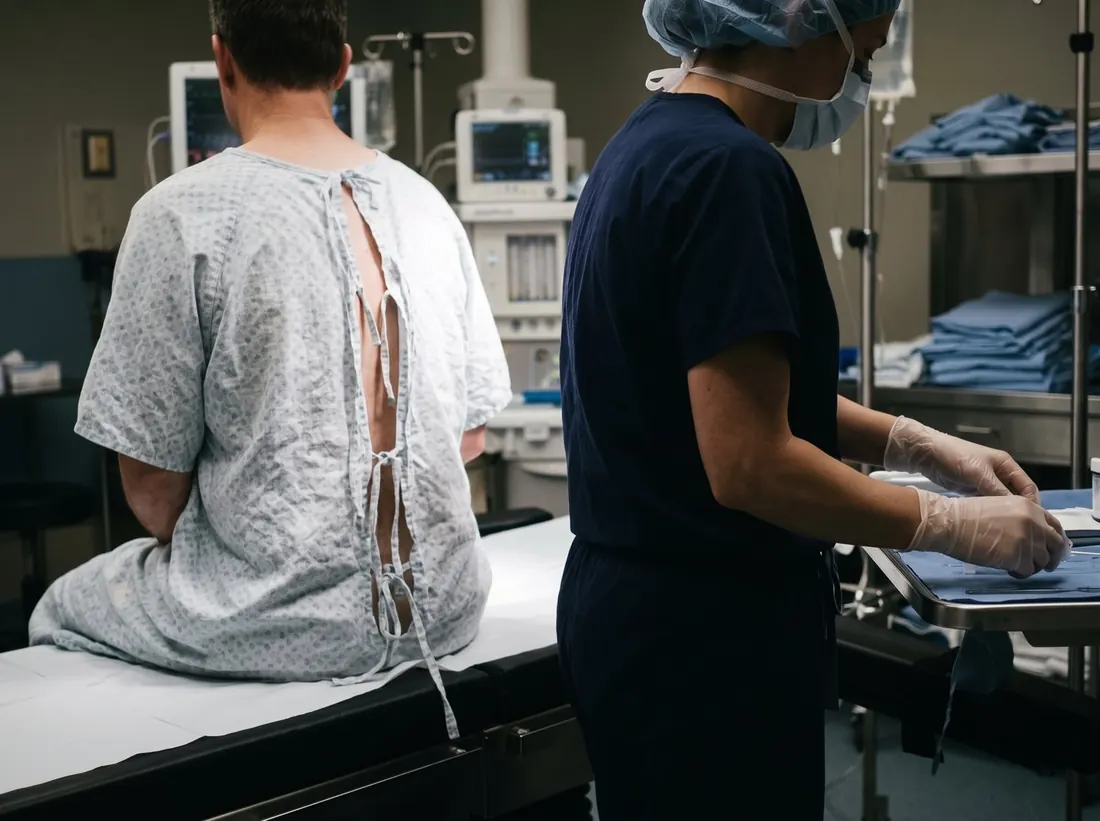
How spinal anaesthesia is given
You sit with your back curved, or lie on your side with your knees drawn up. After the skin is numbed, a thin needle is used to inject a local anaesthetic into the spinal canal. After about 10–15 minutes that part of the body becomes numb and surgery can begin.
Possible complications
No anaesthesia method is entirely risk-free, but serious complications are extremely rare. Modern medicines, precise dosing and continuous monitoring greatly improve safety.
After general anaesthesia
- Allergic reaction to medicines
- Stomach contents entering the airways
- Nausea and vomiting
- Headache, dizziness, weakness
- Sore throat, hoarse voice
- Injury to teeth or mouth
After spinal anaesthesia
- Temporary headache
- Mild dizziness
- Briefly lowered blood pressure
- Discomfort at the injection site
A well-prepared patient and the right anaesthesia are the foundation of successful surgery.
Book a consultation